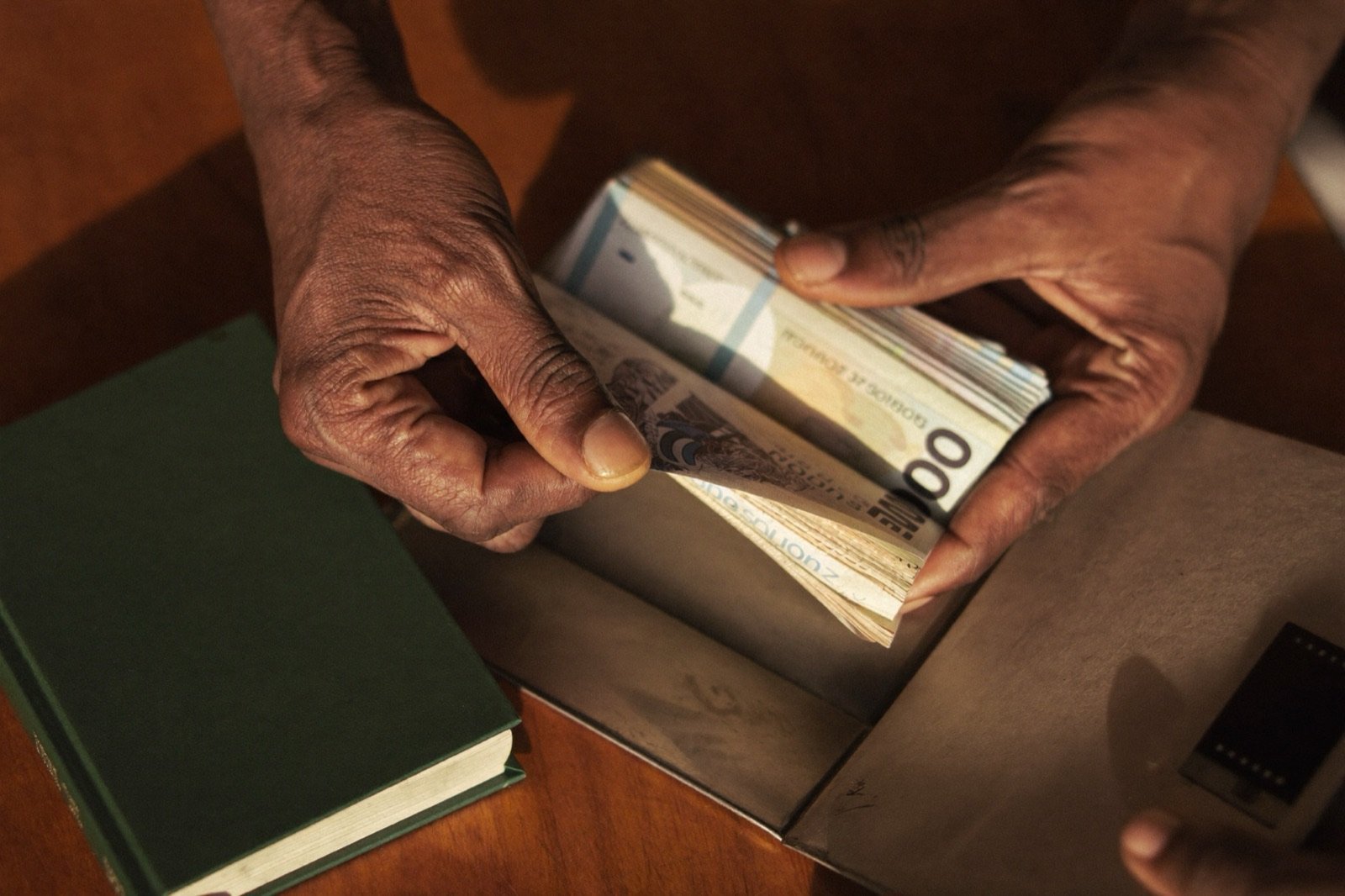
Run your savings group on a book that always adds up.
Hisa and Jamii month by month, loans that three officers must each sign, the cash book, and a year-end gawio split to the exact cent. Every member can open it on their own phone.
The interface is in English. The money keeps the names your group gives it.
Hisashares
Jamiithe community and welfare fund
Kiingiliojoining fee, charged once
Fainia fine
Mikopoloans
Ribaloan interest
Adhabua penalty added to a loan
Marejeshorepayments
Hali ya denithe balance still owed
Faidaprofit
Gawiothe year-end share-out
Salio halisicash actually in hand
Built against a real group’s annual report. Every figure was checked against the workbook’s own totals before it was let in, and one disagreement was enough to stop the import.
The book stays the group’s. The app only refuses to let it contradict itself.
The group's year
Four things a group does. One book that keeps up.
Horizon Vikoba follows the year the way your group already runs it. Nothing is retyped at the end, because it was recorded as it happened.
01Hisa na Jamii
Contribute
Each month's Hisa and Jamii go into the grid as they are paid. Kiingilio and faini sit beside them, so a member's statement shows everything.
02Mikopo
Lend
A member asks. The app writes the letter, the three officers each sign, and riba is charged once at your group's own rate for that term.
03Marejesho
Repay
A schedule dated from disbursement, arrears shown the day they are late, every balance derived from the ledger.
04Gawio
Share out
Faida is worked out, split in proportion to Hisa to the exact cent, and the balances carry into the new year.
What it does
Everything the workbook did, and the things it could not.
A spreadsheet cannot refuse. This book will not let a total go stale, a loan skip a signature, or a share-out miss the pool.
Riba is charged once
A one-off percentage of the principal, at a rate each group sets for itself — 5%, 7% or 10% by term, whatever you agreed. Charge it monthly by mistake and a borrower pays four times over.
Charged once, as the group agreed1,100,000
Total owed 12,100,000
Charged every month, as a spreadsheet lets you4,400,000
Total owed 15,400,000
A 11,000,000 loan over 4 months at 10%. The rate is yours to set: each group keeps its own table by term, say 5%, 7% or 10%. Horizon Vikoba stores it in basis points and applies it once, so the figure cannot drift.
Every member sees the loan book
Pending, active and repaid, with an “only mine” filter. Only the controls differ by office.
Memberread, request
Accountantrecord, approve
Chairpersonsettings, close year
Bring the workbook you already have
The importer checks every figure against your annual report's own totals rows, and writes nothing at all if one of them disagrees.
Hisa sheet foots to Jumla row
Jamii sheet foots to Jumla row
14 member names matched across sheets
Mikopo balance differs from cash book by 20,000. Stopped.
A cash book that says what is in hand
Collections, loans disbursed, expenses and sundry income, month by month, with a running balance kept apart from the contributions total.
Month
In
Out
Balance
April
1,540,000
2,000,000
3,320,000
May
1,610,000
0
4,930,000
June
1,430,000
1,500,000
4,860,000
Made for a treasurer's phone
Pages render on the server and ship almost no JavaScript. They open on a five-year-old handset, on a connection that comes and goes.
One group cannot see another
A loan or member id from another group is simply not found. The people who run the platform hold no office anywhere.
Every act is written down
Including ours. If an administrator ever looks inside your group, a banner says so on every screen and it lands in your audit log.
A member raises their own request and the app writes the letter. Then the chairperson, the accountant and the secretary each answer it, and the app holds them to that.
Nobody signs their own loan
An officer who is the borrower steps aside, and the remaining two decide.
A signature covers specific terms
Revise the amount, term, rate, penalty or date and every earlier approval is cleared. Everyone looks again.
A vacant office blocks the loan
If nobody holds one of the three offices the request says so and stops. It is never waved through.
Asking again is allowed
A member with a loan out can still ask. The officers see every live loan and what is late on it, and make the call.
Ombi la MkopoSignatures required
01
Chairperson
Whether the group should lend this, to this member, now.
Sign
02
Accountant
Whether the cash is there, and what else the borrower still owes.
Sign
03
Secretary
That the request, the terms and the guarantors are recorded as agreed.
Sign
Faida to share, 2026
1,240,000.00
Member A228,220.86
Member B228,220.86
Member C228,220.86
Member D228,220.86
Member E136,932.51
Member F190,184.05
Parts add up to1,240,000.00
Gawio
The year closes in three moves, and the split is exact.
This is the week that used to take an evening with a calculator and end in an argument about the last few shillings.
1
Work out the faida
Riba charged, plus sundry income, less miscellaneous expenses. The figure comes from the ledger, not from a cell someone typed.
2
Split the gawio
The profit is divided in proportion to each member's Hisa by the largest-remainder method, so the parts add up to the pool exactly.
3
Carry the balances forward
Closing Hisa and Jamii open the next year, closing cash becomes opening cash, and the new year goes active.
A year that made no profit still closes, because its balances have to carry forward either way. Closing is reversible: reopen a year and its share-out is discarded so it can be worked out again.
Reports
Seven reports the group already recognises.
Each one has a year switcher and is laid out to print, because the annual meeting still happens on paper.
Scroll sideways to see them all.
Annual report
Fund position, collections, lending, and a per-member table that foots to the group total
Hisa
Members down, twelve months across, opening balance and Jumla
Jamii
The same grid for the community fund
Mikopo
Every loan: dates, principal, riba, adhabu, repayments, balance owed
Hesabu za fedha
Month-by-month collections, loans out, expenses and running balance
Gawio
The share-out — projected while the year is open, frozen once closed
Member statement
One member's full history, theirs to open at any time
Trust
A savings group runs on being able to check.
So the app is built to be checked: by the members, by the officers, and by the group as a whole.
Whole numbers only
Every amount is a whole number of cents, held as an integer. No floating-point value ever touches a balance.
Checks run on the server
Permissions are one table, and the guards run for every page and every action. Never in the interface alone.
Undo is exact
Recording a repayment and removing it are exact inverses. A closed year can be reopened. Both land in the audit trail.
Outsiders leave a mark
The platform owner cannot read your books. To look inside they impersonate one of your officers, and your group can see that they did.
Before you start
Questions groups ask first.
Something else? Write to us and we will answer within two working days.
Do we need our own server?
No. Horizon Vikoba runs as a hosted service — your group signs in and starts. It can also be self-hosted against any PostgreSQL database if you would rather hold the data yourself.
Can we move our existing workbook in?
Yes. The importer reads a DBS-style annual report and checks every figure against the workbook's own totals before writing anything. If one number disagrees, nothing is imported and it tells you which.
Does it work on a phone?
Yes. Pages are rendered on the server and ship almost no JavaScript, so they open on a modest phone and a slow connection. Every report is also laid out to print.
What happens if we make a mistake?
Repayments can be removed and the loan reopens; a closed year can be reopened and its share-out recalculated. Recording something and undoing it are exact inverses, and both are written to the audit trail.
Can the people running the platform see our money?
No. Every group screen is closed to them. To look inside they must impersonate one of your own officers, and that act is written to your group's audit log where you can see it.
Can we set our own riba rate?
Yes. Riba is configured per group. The chairperson keeps a rate table by loan term — for example 5% for one month, 7% for two, 10% for three to six — and every loan is charged once at the band its term falls in. Change the table and new loans pick up the new rate; loans already written keep theirs.
Is the interface in Kiswahili?
The interface is in English, but it keeps the group's own terms — Hisa, Jamii, Mikopo, Riba, Gawio — because that is how members read their own reports.
Open your group’s book.
Sign in to the portal, or write to us and we will help you move your workbook across.